Create New/Edit/Duplicate Task wizard
The tables in this section describe the fields that you encounter when creating a new task in the Create New Task wizard, editing a task in the Edit Task wizard, and duplicating a task in the Duplicate Task wizard. You access these wizards from the Task Setup screen.
Note: The screens and fields are identical for each variation of the wizard.
Note: Several of the fields on these screens depend on your selected task type.
Fields on the Create New/Edit/Duplicate Task wizard
 1. General screen fields
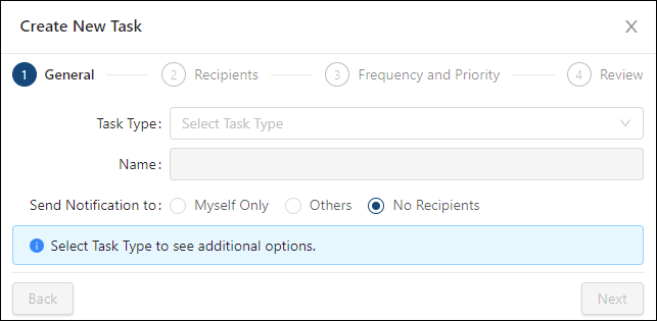
Fields on the 1. General screen of the Create New/Edit/Duplicate Task wizard
| Field | Description | Notes |
|---|---|---|
|
Task Type |
Select the task type from the drop-down list. Options include:
|
The fields on the General screen of the wizard update based on the selected task type. |
|
Name |
Name of the task. You can use the autogenerated name, edit the autogenerated name as necessary, or enter a new name in the field. |
Names are autogenerated for all task types. This field appears for all task types. |
|
Send Notification to: |
Select one of the following options to specify who will receive notifications about the task:
|
This field appears for all task types. |
|
Run As System User? |
When turned on ( |
This toggle appears only if tasks are selected. Reports cannot be scheduled as a system user. |
|
Number of Days Back To Begin Calculation |
Begins the calculation for the specified number of days before the task run date. This setting also accounts for the time of the scheduled task. For example, if a task is scheduled for 12:00 (12 PM) on Monday and is set for 7 days back, it will gather data from 7 days ago at 12:00 (12 PM) and up to the scheduled task’s run time of 12:00 (12 PM) on Monday. |
This field appears for the following task type:
Numeric. |
|
Labor Structure / Edit |
Specify the levels of the labor structure for which the task will run. Select Edit to open the Select Labor Structure dialog box, where you select the levels of the labor structure. |
This field appears for the following task types:
|
|
Weeks to process before planning period start |
Projects hours back to the specified number of weeks before the current planning period. |
This field appears for the following task type:
Numeric. 1 – 4. |
|
Weeks to process after planning period end |
Projects hours up to the specified number of weeks after the current planning period. |
This field appears for the following task type:
Numeric. 1 – 4. |
|
Standard Set |
Change the standard set for which projected hours are generated. By default, projected hours are generated for the standard set specified in the Property Labor/Scheduler Setup screen. |
This field appears for the following task types:
Default: Default (the standard set that is defined in the Property Labor/Scheduler Setup screen). |
|
Rotate Days Off |
Select the check box if you want to rotate the days that employees are off. |
This field appears for the following task type:
|
|
Days to process (before yesterday) |
Offsets generated standard hours for the specified number of past days of actual KBI volumes. |
This field appears for the following task type:
Default: 21 Numeric. 1 – 35. |
|
Clear Schedule |
Select the checkbox to clear schedules when the tasks are run. |
This field appears for the following task types:
Default: The checkbox is not selected. |
|
Recalculate KBIs |
If selected, the Generate Projected Hours task will recalculate all calculated KBIs as part of the generation process. |
This field appears for the following task type:
|
|
Back |
Return to the previous screen in the wizard. |
This button is unavailable on the first screen of the wizard. |
|
Next |
Go to the next screen in the wizard. |
This button is available only if you have entered data into all required fields. |
 ), the task can be run as a system user (Property Admin or All Properties Admin). This ensures that scheduled tasks do not depend on a specific user and will continue to run if the user who created the task has been deactivated.2. Recipients screen fields
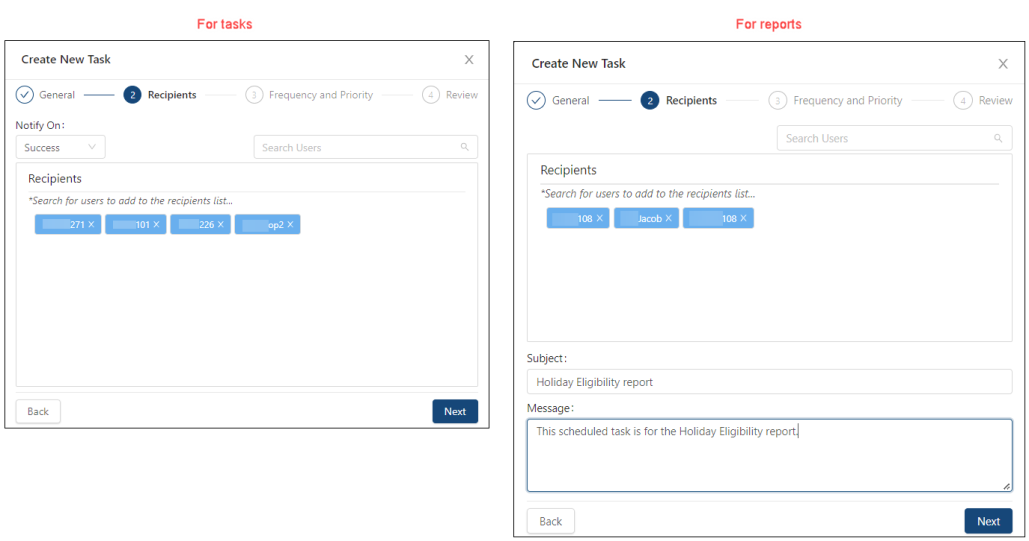
Fields on the 2. Recipients screen of the Create New/Edit/Duplicate Task wizard
| Field | Description | Notes |
|---|---|---|
|
Notify On |
Select whether tasks are notified on success, failure, or both. |
This field is not available for reports. |
|
Search Users
|
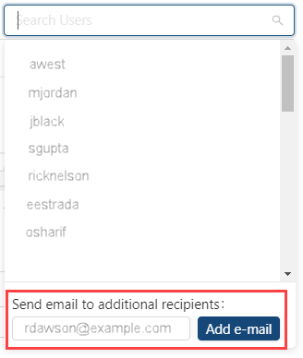
Search by user ID or add a new user. Do one of the following:
|
The list of users populates based your database access. If a user is mapped to an employee record, the user's name from the employee record appears. If a user is not mapped to an employee record, the user's login ID appears. Users must have a valid email address. |
|
Recipients |
Each selected recipient's user name appears in a tag. To remove a recipient, select the X in the tag. |
This field is populated only if you select users. |
|
Subject |
Subject line of the notification message. |
This field is only available for reports. |
|
Message |
Message content of the notification. |
This field is only available for reports. |
|
Back |
Return to the previous screen in the wizard. |
|
|
Next |
Go to the next screen in the wizard. |
This button is available only if you have entered data into all required fields. |

 ) field and select a user from the resulting drop-down list.
 3. Frequency and Priority screen fields
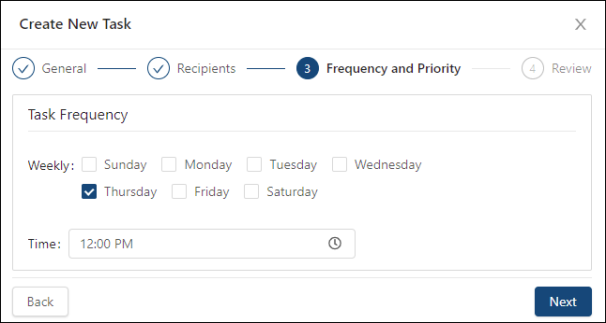
Fields on the 3. Frequency and Priority screen of the Create New/Edit/Duplicate Task wizard
| Field | Description | Notes |
|---|---|---|
|
Task Frequency |
Tip: You can specify only one run time for a task. If the run time varies for a task that will run multiple times per week, you can create a separate scheduled task with the same settings but specify a different Time. Duplicating a task is helpful for these scenarios. |
If a task can be run for multiple days, you can select multiple weekdays. If a task can only be run once a week, you can only select one day. Multi-select for other weekdays will not be available. |
|
Back |
Return to the previous screen in the wizard. |
|
|
Next |
Go to the next screen in the wizard. |
This button is available only if you have entered data into all required fields. |
4. Review screen fields
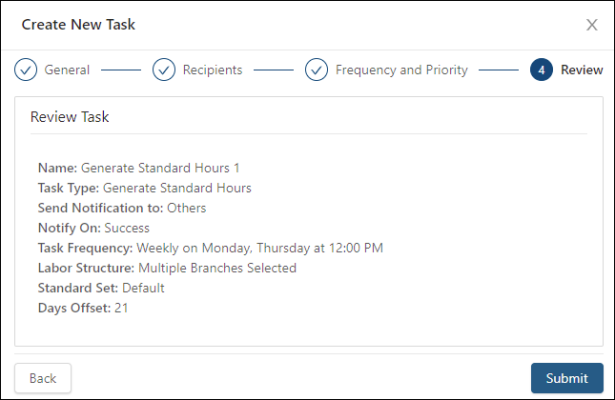
Fields on the 4. Review screen of the Create New/Edit/Duplicate Task wizard
| Field | Description | Notes |
|---|---|---|
|
Tasks details |
The details for the task depend on your configurations in the previous screens. For field descriptions, see the following help pages: |
Read-only. |
|
Back |
Return to the previous screen in the wizard. |
|
|
Submit |
Submit your notification configuration and close the wizard. |
|